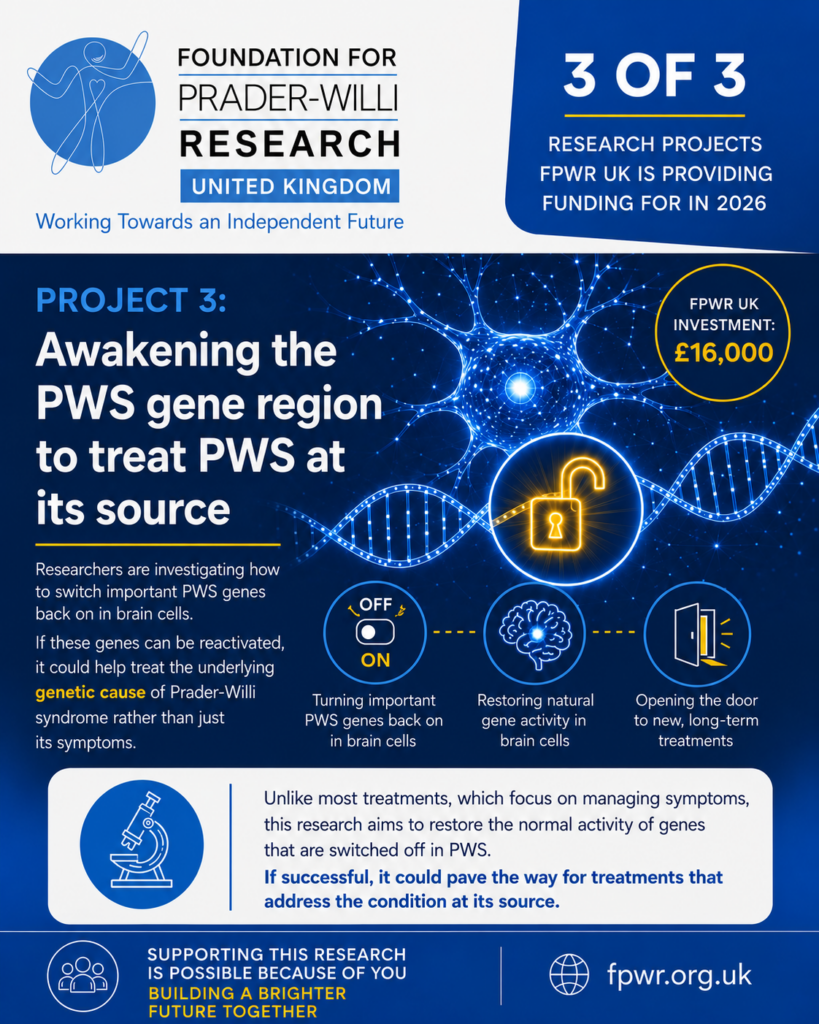
At FPWR UK, we are committed to supporting research that has the potential to change lives. That’s why we are delighted to announce that FPWR UK is investing £16,000 in an exciting new research project led by Professor Charles Gersbach, in partnership with the Foundation for Prader-Willi Research (FPWR).
This is the third of three research projects that FPWR UK are funding this year, and we are excited by the potential this project has to transform how PWS is treated in the future.
Looking Beyond Symptoms
Many current and emerging treatments for PWS focus on managing specific symptoms, such as hyperphagia, behaviour challenges, hormone deficiencies or sleep difficulties.
This research takes a different approach.
Rather than targeting individual symptoms, Professor Gersbach and his team are working to address the underlying genetic cause of PWS.
A Different Way of Thinking About Treatment
In PWS, important genes that would normally be active on the paternal chromosome 15 are missing or cannot function correctly. However, maternal copies of these same genes are also present, but they are naturally switched off. Researchers are working to understand whether these silent genes can be safely reactivated, allowing the body to use instructions that are already there.
This is where the term “epigenetic activation” comes in.
In simple terms, the researchers are developing specialised tools that may be able to switch these silent genes back on. If successful, this could restore the activity of genes that are important in PWS.
Importantly, the team is not trying to permanently rewrite a person’s DNA. Instead, their approach aims to reactivate naturally silenced genes without changing the underlying genetic code itself.
Building on Encouraging Results
This project builds on research that has already shown promising results in the laboratory.
Professor Gersbach’s team has successfully reactivated these silenced PWS genes in stem cells derived from people with PWS. Even more encouragingly, the genes remained active as those stem cells were developed into brain cells.
The next challenge is to achieve the same result directly in mature brain cells, known as neurons.
Because neurons play such an important role in PWS, the researchers will investigate what is preventing the genes from being switched on in these cells and develop strategies to overcome those barriers.
Why This Research Matters
One of the most exciting aspects of this work is its long-term potential.
The ultimate goal is to develop a treatment that could be given once and produce lasting effects by restoring the activity of important PWS genes. While there is still considerable work to be done before this could become a treatment for people with PWS, the project could provide critical knowledge needed to move closer to future clinical trials.
If successful, this approach could represent a major shift in how PWS is treated, moving beyond symptom management and towards addressing the condition at its source.
Benefits Beyond PWS
The impact of this research may extend beyond Prader-Willi syndrome.
By helping scientists better understand how to reactivate silenced genes, the findings could also contribute to research into other rare genetic and imprinting disorders. The knowledge, tools and data generated through this work will be shared with the wider scientific community, helping to accelerate progress across multiple fields of research.
Thank You for Supporting Research
This investment represents exactly why FPWR UK exists: to support bold, innovative research that has the potential to make a meaningful difference for people living with PWS and their families.
This would not be possible without our amazing fundraisers and donors and we are so grateful for your support.
To find out more about this project please visit www.fpwr.org/fpwr-funded-projects/epigenetic-activation-of-the-pws-locus-in-post-mitotic-neurons